
"Random forests as the name suggests grows large number of decision trees from randomized subsets of variables and observations from the input data. This overcomes influence bias and over-fitting effects, often yielding better accuracy compared to decision trees, but costs intensive computations."
cforest() is party’s implementation of random forest. The example below shows how cforest() can be implemented to predict the outcome. Besides prediction, random forest can also be separately used for variables selection if you choose to pursue other methods.
Prepare Training and Test Data
library (party)

data ("GlaucomaM", package = "ipred")

inputData <- GlaucomaM  # plugin your data here, with 'Class' as dependent variable

set.seed (100)

train <- sample(1:nrow(inputData), 0.7*nrow(inputData))  # random sample

trainData <- inputData[train,]  # training data

testData <- inputData[-train,]  # test data
Predict with cTree
cTreeMod <- ctree (Class ~ ., data = trainData)  # fit cTree with 'Class' as dependent

actuals <- testData$Class # actuals

predicted <- predict(cTreeMod, newdata = testData) # predicted

table(true = actuals, pred = predicted) # confusion matrix

mean (testData$Class != predicted) # Misclassification Error %
# Results Output: cTree()
             pred
true     glaucoma normal
glaucoma       15      7
normal          2     22
Misclassification Rate: 19.6%
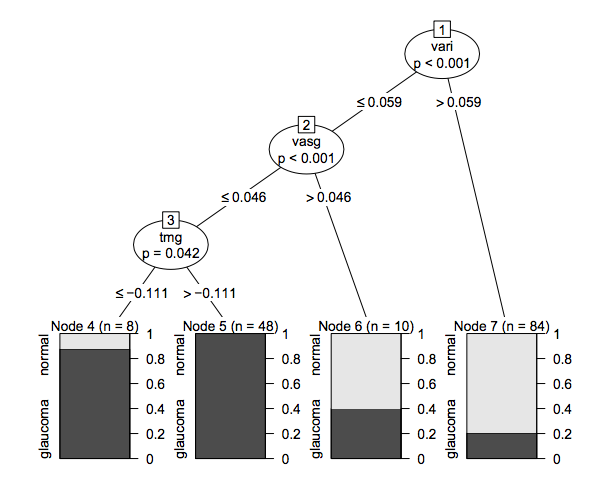
Predict with cForest
cForestMod <- cforest(Class ~ ., data = trainData)  # random Forest model

actuals <- testData$Class # actuals

predicted <- predict(cTreeMod, newdata = testData) # predicted

table (true = actuals, pred = predict(cForestMod, newdata = testData))

mean (testData$Class != predicted) # Misclassification Error %
# Results Output: cForest()
             pred
true     glaucoma normal
glaucoma       19      3
normal          3     21
Misclassification Rate: 13%
cForest() improves the prediction accuracy compared to cTree(), however, it does not have the visualization capabilities that cTree() offers.


